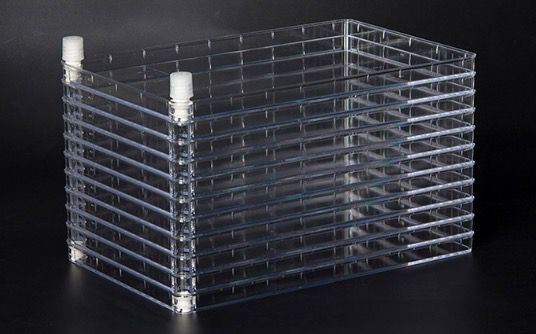
Steps to Collect Cells in a Multilayer Cell Culture Flask
1. Remove the culture medium.
2. Rinse the monolayer.
A. Add the recommended volume (40 to 50 mL per layer) of CMF-PBS to the flask. Stopper tightly and distribute the CMF-PBS evenly in each of the top layers by tilting it toward the longest side.
b. Once the medium has leveled, stand the flask to separate the layers, then from the setting down to a safe position. Refocus both studies to thoroughly rinse each layer and remove all old medium.
c. Remove and discard the wash solution. A second wash with CMF-PBS is recommended to prevent difficult cell growth.
3. Separate the monolayer.
A. Add the recommended volume (20 to 30 mL per layer) of pre-warmed separation solution to the station and distribute evenly to each station by following the wash steps. Pre-warming the dividing medium will reduce the subsequent time required.
b. Relaxing the high walls can help to detach the cells from the surface.
4. Gently tilt the plate side to side and from end to end to evenly distribute the dividing medium across each layer. Relaxing the high walls can help to detach the cells from the surface.
Recommendation: It is recommended to grow the same cells under the same conditions (cell density and relative media volume) in a control culture vessel, as the effects of cell growth analysis cannot be directly monitored from above. This control culture vessel (usually a 1-layer flask or station) can then be treated in sequence to monitor cell growth and the progress of the cell enlargement procedure.
5. Collect the resuspended cell suspension in a centrifuge tube or a plastic or glass bottle. Neutralize the dividing medium (if possible) and place the cells on ice. To recover additional broken cells remaining in the colloid, one or more additional washes may be recommended:
A. To facilitate cell removal, this wash may be performed with CMF-PBS or medium, which is then added to the cell suspension from the first division.
If a large number of viable cells are found in the solution wash, a second wash may be recommended or adjustments to the fractionation or collection procedure may be required. (See step b below.)
If the wash solution contains few viable cells, this step may be omitted.
b. For cells that are difficult to remove, a pre-warmed fractionation solution may be recommended. It may be necessary to incubate the cells for a few minutes to allow the solution time to act on the remaining Gmail cells.
If a large number of viable cells are found in the second wash, adjustments to the fractionation or collection procedure may be required.
If the harvest contains few viable cells, this step may be omitted.
6. Inactivate or remove nucleases.
Some nucleases should be removed immediately by centrifugation to release the elongation that may cause cell colloidal or cytotoxicity, especially when combined with serum-free media.
However, other nucleases, considered limiting, such as trypsin, can be inactivated by adding cold media containing serum or trypsin inhibitor and do not need to be removed.
If removal is desired, gently spin the cell suspension at 100 x g for 5 minutes. Then, discard the nuclease medium and replace with fresh medium.
7. Count cells to determine cell yield and viability.